Monday, November 23, 2015

Curiosities and Fauna

How people toss their garbage around the world says a lot about the culture. If you read my blog from Honduras, you might remember how people just walked over mounds of garbage in the street. I remember asking someone if it would make a difference if I got a bunch of garbage bag and picked it up. They just shook their their heads.

I can't help watching garbage collections wherever we are because it says a lot about levels of service. Here the collectors wear long green stockings, black shoes, beige shorts and green shirts. Depending on the area, people put their bags out at the curb as we do or in their own bins if the have a nice house. Here are a few we passed today --

   Acess from both sides.

           A simple bamboo pole.

In this type, garbage can be dropped over the top of a wall into a neat little basket.

On the other hand, you watch out for live wires while walking down tne street.


This afternoon while on a hike I tried to photograph birds. But they wouldn't sit still. But the plants did. Maybe you know what they are.


There were a lot of these in Honduras.


Tomorrow evening we start our long trek to Florida, arriving the next day. Sleep well. More tomorrow.


The Nature of the Beast

Yesterday Saphira said,"Lynda, (She calls me that.) please help me find a bug -- and she showed me this drawing --


Imagine pretending that you are looking for such a bug under every leaf in a lush forest of vines, towering trees, carefully lifting leaves not knowing what you'll find underneath. I finally said to Saphira that it was a very difficult thing to do.

Later, some papers blew off the deck into the forest and so Bob and Saphira spent half an hour with long pieces of bamboo trying to retrieve them. While I was taking pictures, my lens cap fell into the thick of it. There are snakes in there, the unfriendly kind. Eventually, Brian found the cap.

              Searching

            Preparing dinner.

                 Saphira

More tomorrow. We are 27 degrees southof the Equator here.


Sunday, November 22, 2015

Brazilian Tea Culture and Friends


This morning Ken Love, the cofounder of FILES, THE Floripa International League of English Speakers, brought his Chimarrão (made from a calabash gourd -- in the photo above) filled with Yerba mate to breakfast at the hotel where we are staying. He also brought a thermos of hot water. You can see the tea at the front top of the Chimarrão.

 Brazilian tea culture began with infused drinks made by the indigenous cultures of the Amazon region. It has changed since the Portuguese colonial period and now includes imported varieties of tea. Mate, a caffeinated infusion is made from the leaves of the native yerba mate plant. 

Mate, also popular in Argentina, Paraguay, and Uraguay, is drunk from a hollow gourd using an ornate silver straw, as you can see in Ken's Chimarrao above.


Helena, a Brazilian teacher, me 
and Carmem a Romanian marketer 

          More Feles members

Bob and I with Brazilian Geometrc artist Cassia Aresta
this morning at her home studio. More of Cassia's work soon.

Nésia, Brazilian owner of apartments

I'll leave you for today with a precious Brazilian flower


         some bananas

and a pair of funky shoes.

Best thoughts,
Lynda


Saturday, November 21, 2015

Family and a Global Community


      Augustan de Lassus

 
   More below on Augustin de Lassus

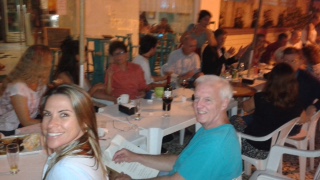
Yesterday we met a gregarious American/Brazilian entrepreneur who started an organization of people from around the world living and working here in Florianopolis. He invited us to a dinner last evening in the same posh area of Jurere where we saw white mansions and miles of beaches the other day. 

It was such a heady experience the excitement of which was giving me a headache last night. It was so different from our peaceful Caledon life watching squirrels and deer. Next to me sat a Romanian mother who graduated in the marketing field in Bucharest.

           A heady group

Across from us a German linguist who analyses contracts written by criminals engaged in money laundering. He searches for language ambiguities for the federal police. As you know, Brazil is rife with corruption. There were 25 at the table last evening-- artists, lawyers, IT folks, investors, developers and on and on. 

      The German linguist

Yesterday in Jurere I stumbled into French artist Augustin de Lassus's gallery (His art is above). I love his his bold style and use of primary colours. Lassus has a small gallery near the shopping mall "Open Shopping." His style is called "naive."

I don't know how familiar you are with the work of the Spanish artist Joan Miro. Brian, Bob and I saw an exhibition of his work at the Florian art gallery last Sunday. His work is evocative and complex.

               Joan Miro

Geometric Artist Cassia Aresta

Today we are going to a beach to play paddle ball. We met Cassia Aresta, one of the top ten geometric artists in Brazil at a cafe in St. Antonio on the way to Brian's place. She invited us to her studio.

Later, Bob and I stood looking at Cassia's art spread out on a large work table. "What does it mean to you? she asked me. I struggled to find an answer because geometric art isn't like symbolic, impressionistic or landscape art where you can easily find meaning. And yet the concept for some of Cassia's art is a photograph rendered into shapes. So I talked about the design and the relationship of one shape to another -- the space in between. Not a very enlightened answer I'm afraid.


                    Aresta's work

Life is exciting, complex and sometimes a stuggle. I suppose if it weren't we couldn't grow and develop. I wish Bob and I could stay longer here. We are only just scratching the surface and two years is far too long to be away from a son and a granddaughter.

More soon. We fly to Tampa on a red eye late next Tuesday. If an iPad USB adapter isn't too expensive, I'll send the photos you've missed next week from Florida.

More soon. Hugs, Lynda 


Wednesday, November 18, 2015

Things Work Out


This is the licence plate of our car, the damaged one that I've been fretting about -- SC, the state of Santa Catarina. We took it back to Avis at the airport yesterday and wonder of wonders, they were very professional about the estimate. At $450, we don't feel fleeced. 


The car next to ours in the hotel parking lot. Seems odd. So far away from home.

What better way to celebrate than at Joaquine Beach one of the best global surfing spots. Santa Caterina Island, is a meca for surfing and surfing championships. You watch a hug wave roll in and suddenly surfers rise from the trough to the crest looking as though they'll take flight. In another life I would have been a part of this scene. 

This is a tough sport. Getting up onto the board is no mean feat.

      Getting suited up.

The woman getting zipped up in the photo above is in the background of this photo and didn't manage to catch one wave.


Not far from the beach, sandboarders, slide down mountains of sand built up by the wind. 


People are friendly and helpful. We've just come in from a walk and felt safe on the night streets. Communication is strange though. Not many people speak English or Spanish. We have to sift and sort for ourselves more here in Brazil than in Central America and Equador.

See you soon. It's very hot here and not summer yet.


Monday, November 16, 2015

Art of All Kinds


The artist above introduced himself as a local painter giving his time to help elephants wounded by landmines. He is contributing to The Elephant Parade, an annual charity benefit. This year 50 elephant sculptures painted by local artists will be on display in Florionopolis in November. At the end of February the elephants will be purchased by auction. The charity is spreading globally.

  sculpture ready for street viewing and auction

           almost finished

                 street art

Nature's Art


          nature's delicacy

             Vines are like rope here --

    and lichen multicoloured.


Another kind of art --- nature's art through the ages. This moss covered odd structure is a 1700s water access. The water came from a kind of cistern above (that looks no more than a pile of rocks now) and was retrieved somehow inside this conical building.

      part of a 1700s fort

The Portuguese colonized Brazil in the 1500s wresting the land from the 7 000 000 native tribal indians living here at the time. The tribes lived in temporary dwellings in villages of up to 5 000 people. They warring with other tribes and practicing cannibalism. Hardly more than 200,000 indigenous people survive now, mostly living in the jungle.

Tomorrow we'll check out and head for Avis car rental at the airport, bracing ourselves for the damage estimate. It's strange after all these years it's my first accident. Not easy to back down a steep hill in a narrow parking lot after 30 hours of travel. What a dolt I am to have tried it in the first place.

See you tomorrow.

Many cheers, Lynda