Sunday, February 5, 2012

A Trail of Blood at the Museo Amparo

Yesterday, Bob and I were in the courtyard and had just entered the Museo Amparo when I heard someone call for a first aid kit. I turned toward the central fountain. Two older women were walking slowly toward the desk where backpacks were secured. One of the women was leaving a long trail of blood behind her.

An employee brought the first aid kit as the woman's friends helped her onto a bench and elevated her leg. Someone pulled up her pant leg and the employee opened the first aid kit. I looked inside. There was a puffer and a couple of enormous rolls of something. Well stocked kit, I said to myself.

I bent over the woman and introduced myself. I checked her leg. She had a deep, jagged gash from just below the knee to just above the ankle. I asked someone to get a plastic bag for a tourniquet. Someone gave me a man's necktie and I secured it around her upper leg.

The woman, her name was Harriet, was amazingly. calm. Her four friends were at a loss as to what to do, though. I said that if Harriet had her Visa, she be OK for suturing at the hospital. But she need her passport at some point.

The group of women, who were Smith College alumni from the Seattle area, had just taken another member of their group to the airport for an early flight home. She had a detached retina. There but the grace of God go we. They were lovely women. I wish I'd known them in their younger years.

I overheard one of the museum employees say that the museum would cover medical expenses. I told Harriet what I'd overheard. I suggested she get s Tetanus booster shot if she hadn't had one recently. The Red Cross arrived, the cleaners washed away the trail of blood from the ancient stones and Bob and I carried on our way to view the Pre Columbian exhibits.

Later I visited Harriet in her room in our hotel. All had gone well and the museum folks had been wonderful, one of them had gone with her to the hospital. She was going to claim expenses on her own insurance so I offered to email her a photo of the fountain gutter she'd fallen into.

Last night we attended a jazz concert -- bass violin, electric violin and keyboard at the same museum. As we passed by the fountain I looked to the ground. Not a trace of blood.

Friday, February 3, 2012

Mexico City Eco Bikes


Mexico City was a surprise. In the city outskirts and many districts not far from the centre, things are a little dodgy. But the downtown business area where our hotel was tucked away, has a distinctive North American feel with clean streets and tons of Starbucks -- would you believe.

Buses arrive on time and the city has a modern system of eco bicycle stations where you can swipe your credit card for a year of 30 minutes or up to one hour rides for $24 +. It's well used and where streets are heavily trafficked, the sidewalks are wide enough for cycling. The transportation beats Toronto's hands down.

We're both looking forward to an easy pace in Puebla until the afternoon of the 5th when we leave for a four hour bus ride to Oaxaca. The last couple of days have been fairly intense.

We did a ton of walking and climbing at the Pyramids and spent every minute we had yesterday at the enormous, modern and impressively designed Archeological Museum. Artifacts from the indigenous peoples of South and Central America are housed artistically and the walls are covered with amazing replicas of advanced forgone era. We're soaking it all in.

I'm feeling comfortable with Spanish and am starting to feel proud that I can really carry on a conversation now on almost any topic. It's taken ten years to get to where I am now with the language. But I can see that with a few more big pushes, I'll be relatively (with a focus on the relative) fluent.

I'll post more photos.

Be well,
Lynda


In a XVI Century City

Puebla

If you've seen colourful Mexican tiles, imagine buildings faced with tile instead of stucco. It's amazing to see XVI century buildings in the historic centre covered with their original tiles. Our hotel here was a convent 400 years ago.

The nuns were forced to leave in the 18th century. I suppose the building was used for something else after. But in the 1980s it was converted to a hotel. The ceilings in the hallways have their original beams -- the stone stairways are as they were.

Our room here is larger than our living and dining rooms at home. Stone benches line the exterior wall with windows looking down to a red an yellow stucco courtyard with fountain.

When we walk the hotel's long hallways I imagine the nuns walking along in silence, the only sound the swishing of their habits. I love hotels with unique character.

I'll attach more photos to each post later. Getting the hang of blogging on this iPad has been a challenge!

Adios until later -- Lynda


- Posted using BlogPress from my iPad

Thursday, February 2, 2012

City of Sculptures

Before leaving home a friend warned me not to carry a purse in Mexico City. But where do you put your stuff, I wondered. So the night we arrived on the way to dinner I clung to the purse slung across my shoulder and hugged my DSLR Nikon tight to my chest.
The next day I described to a seasoned Latin American traveler how I was keeping my stuff safe. "You'll attract attention that way!"
So now I just walk along and watch my back. We feel safe here. There are lots of police both the regular variety and and special tourist police.

Today at the Basilica of Our Lady of Guadalupe we saw penitents walking on their knees to the new basilica.

The old church is more like a museum now. You can see a photo of the hand of a saint in bronze below. All masses are held in the new church which is remarkable for its copper enamel art on the exterior. The colors are amazing.


We're on our way to Puebla now.
Hasta la vista


Wednesday, February 1, 2012

Teotihuacan and Mexico City

Sometime around 750 CE the inhabitants of this city burnt down their houses and left the area. It happened after 10 year drought and both the inhabitants and their rulers believed they had wronged their gods.

You can walk around in the rooms bordered by the remaining stone walls.
Just as in Knossos on the island of Crete, the surrounding dwellings had an elaborate underground system of pipes to transport water.

Archeologists haven't discovered tombs in the Pyramids of the Sun and Moon.. But in the Sun Pyramid they found a tunnel leading to a cave with four petal- like sections formed around a circle. It was here that the bones of many children were found. They were sacrificed to the gods. You'll see a photo below of a bas relief of this design that figures in much of the indigenous people's art.

I felt emotional seeing the tiny figures these peoples produced. They are so precious and finely wrought. Some of the photos below are from the Museum of Archeology in Mexico City and others from the Amparo Museum in Puebla.

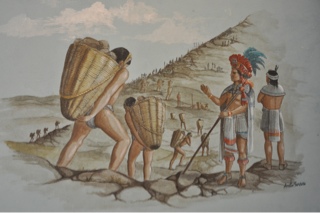
You'll see an artist's conception of of a market near a pyramid. A man is flattening paper for sale. The woman is selling jewelry. In another photo you can see how the pyramids were constructed on the backs of men.

We have technology -- but these peoples who lived so long ago, brutal as theirs lives seem to us now, were incredibly advanced in their workmanship and thought.

You'll see a painting of a competition between two men. Can you imagine that the victor of the game might have had the honour of being sacrificed to the gods?


Tuesday, January 31, 2012

Casa Gonzalez, Mexico City

Casa Gonzalez, Mexico City

Raphael, our taxi driver said, "Look over there!" We craned our necks over snarled traffic to watch the driver of a truck mounded with "spiders" clamp a metal contraption the size of the raccoon trap in our Caledon garage onto the wheels of an illegally parked car.

Billboards advertise "Hugo." Bent over elders sweep the streets with heavy straw brooms. The narrow streets are filled with vendors a little like those in Bangkok. Third worldish buildings mingle with those of glass and gleaming metal.
We took a circuitous route from the airport to the hotel because of mass demonstrations in the city centre -- opposition to changes to the electrical workers' unions and wage issues.

I can't believe that getting here was so easy. I expected delays and frustrations in this enormous city with a daytime population of 30 000 000. But services are smooth and orderly and people amazingly friendly.

You might be able to see puddles of water in the photo of our hotel's courtyard. Strangely, the heavens opened tonight -- oddly because we're in the dry season now. Off to the pyramids tomorrow. Hasta pronto.


Friday, January 27, 2012

Mexican Adventure

Mexican Adventure


Next Wednesday February 1st 2012, I'll post photos of this magnificent pyramid and the remains of, the largest city in the pre-Columbian Americas. See you then!


Lynda


Pyramid of the Sun, Teotihuacan


Self Esteem Health